~ by David B. Redpath … September ’86

Taking out a class action, Lenny DeLashwood addressing the jury in exile. A Beasley Street refugee fleeing Chicken Town, open neck shirt lacerated and bleeding, settles down to the relative peace and quiet of a Brixton riot. Recovering from close encounters of the matrimonial kind, with a pepnotised milk complexion, whizz-kid hormones, and black leather plasma flowing through the veins of his prescription sunglasses, the Punk Poet of Havoc in a boiler suit. Put on an aeroplane to Gondwanaland, and a strict cake shop diet, for a third tour of this continent, against the usual tide of British invasions (where the ‘Dead Gandhi’s Razor Gang’ on a seek and destroy missions arrive upon U.S. shores magically transformed into ‘Nelson Eddy & the Nolan Sisters’). Under the sobriquet ‘Mister Siberia’, blurred passport photo and split identity card, customs official unable to pin-point the man behind the hairstyle. His entourage of five hotel rooms, contents nervously fluctuating as John Cooper Clarke the rampant lipster delivers a didactic of jive artistry pushing the speeded verse to street level renaissance man . . . Vers de Societe. Like a lean ferret thrown down a rabbit hole with Alice in Wonderland and a poetic licence to kill, delivering diatribes and platitudes to the descendants of the dead tribes of existential economics. A captive audience at the licenced venue reeling after a poetic tongue lashing. Some in need of rescue.
Recital over we head back to the hotel, passing a night watchman playing ‘Farenheit 451’ on his computer, but Guy Montag has the contraband manuscripts concealed in his room. Carry-bag of black market leather and pizza settling down to an Aussie Inquisition with coffee and conversives subversive translated intravenously through the thicket of a Manchester accent . . .
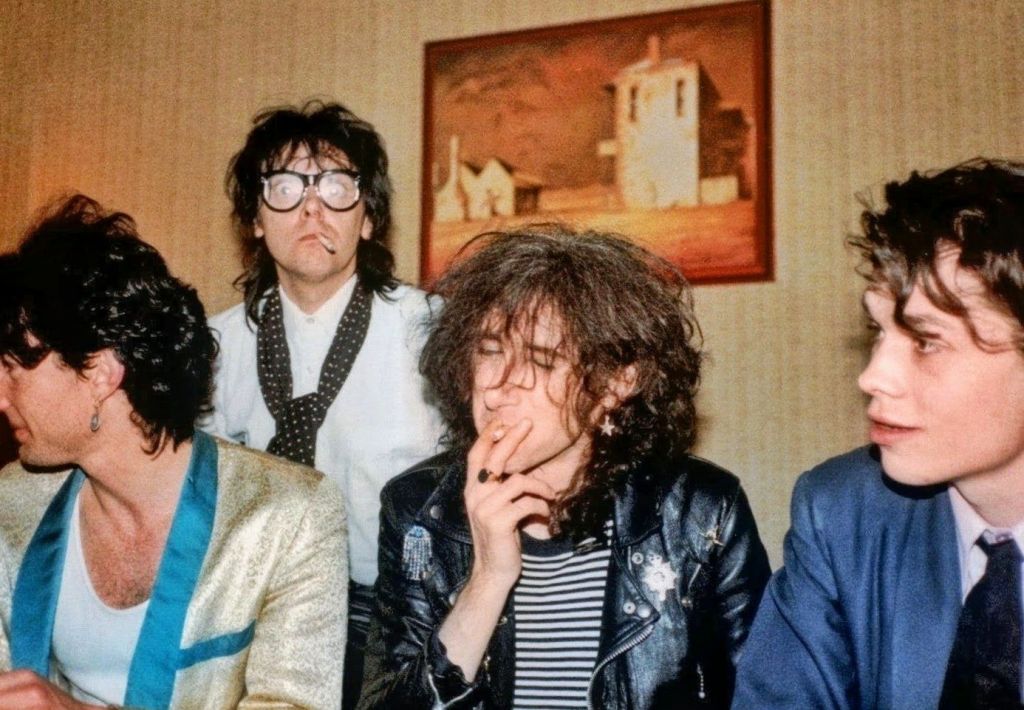
D.B.R.:
The Greeks say poetry is a graft that grows in a wound. Is art self-inflicted?
J.C. Clarke:
They say art is a pharmaceutical
concocted by imbeciles.
I was stricken with T.B. at an early age.
As a result I had a solitary and feverish
childhood with a morbid acuteness of the
senses. Left up to my own devices, crazed
and disturbing. A vivid imagination, all
dressed up, nowhere to go. I had a
catholic-jewish upbringing, I’d go to
confessional, but took a lawyer with me.
With no demands made of me, physical
pain and hard work didn’t enter into my life
till I started school, physical demands
have been the order of the day from then
on, with hard work and very little pay.
I wanted to re-invent myself when I
noticed that poets went down really well
with women. Man needs a liege. “Nurse!”
Everybody needs a nurse. You know,
I’ve got sixteen distinct personalities.
D.B.R.:
Like Sybil … or a television station?
J.C. Clarke:
Sybil had one personality … Sally Field
cut sixteen ways. And Mickey Spillane is
a Jehova’s character witness, with a flat
top crew cut. A real American, but he never
actually gives a physical description
of ‘Mike Hammer’ in his books.
D.B.R.:
A recurring theme in your writings,
the roof falling in and the floor dropping
out from under you, is this all from
personal experience?
J.C. Clarke:
No, it’s always been a big fear of mine.
I used to dream about it because Manchester
was really badly blitzed during the war.
Much of it is still charred ruins. The
most common sights while I was growing
up was bombed houses. A classic insecurity
of mine, homelessness. I look at tramps
and think; how do they live?
D.B.R.:
You can’t miss what you’ve never got.
So, you’ve never been without?
J.C. Clarke:
No. Like I remember the early days of
the welfare state, everybody got glasses
they didn’t need, ripped out all their
teeth for free denture replacement,
because they thought the welfare state
just couldn’t last. “The Tories will be
in next and they’ll abolish the lot!”
Talking conservative, Margaret Thatcher,
the Iron Maiden herself, she is very
popular amongst the yuppies. Young
upcoming professionals upwardly mobile
social astronauts.
D.B.R.:
With the young upcoming downtrodden
workers manning the launching pad?
J.C. Clarke:
It’s a failure in its own terms, England
now, but it’s the last place in the world
that would go communist. The English wrote
the book on capitalism. There you’ve got an
inversion of the capitalist equation, with
the rich being nationalised, the workers
buying shares in the newly privatised
industries, the established rich painfully
aware of their privilege and embarrassed
by it (unlike the nouveau riche). The best
socialists Britain ever produced came from
public schools, like Cambridge.
D.B.R.:
And the best Russian spies Britain ever
produced, defecting to elitist tourist
resort politics.
J.C. Clarke:
With the new Karl Marx Book,
‘Expresso Manifesto’, for the young
revolutionary with dialectic umph?
Questions without terror!
Oh my God, the party line’s disappeared.
D.B.R.:
Francois Mitterand?
J.C. Clarke:
And Margaret Thatcher, now there’s
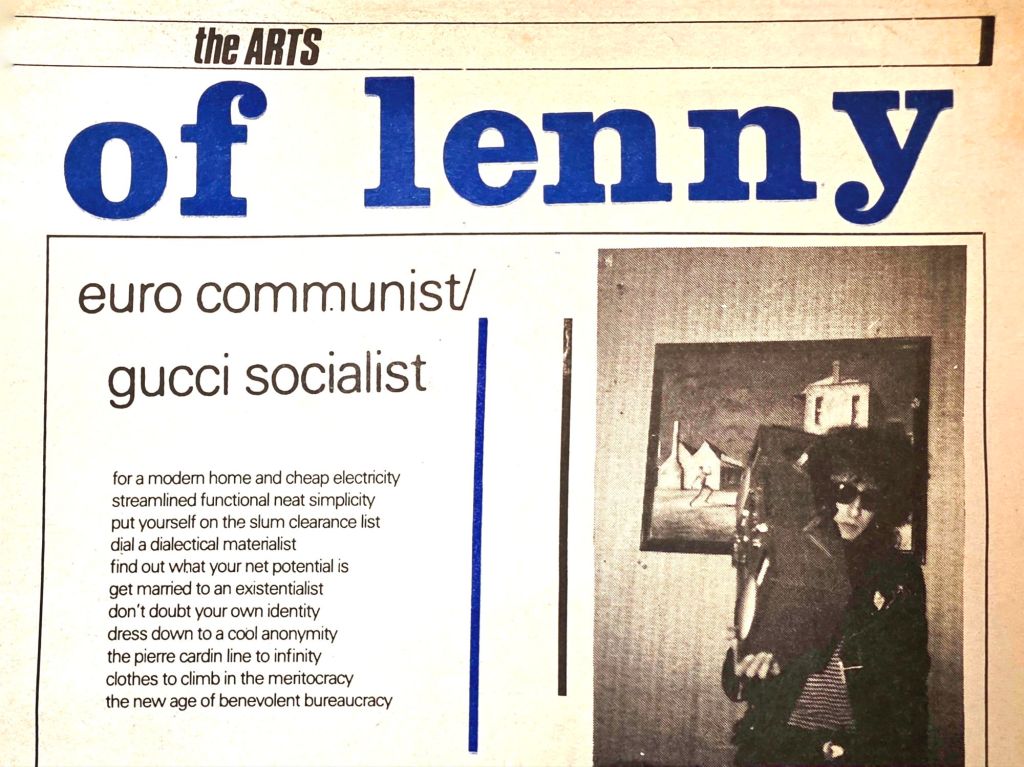
a combustible marriage. He’s a gucci
socialist really, of which I class myself
I think. You can reconcile it with the
catholic church, it’s cool … that’s me,
a euro-socialist.

D.B.R.:
Bob Geldof’s recent achievements?
J.C. Clarke:
A very clever and very charming young man.
One of nature’s gentlemen. People say all
sorts of things about Bob, how it’s a
career move. But I say dangerous talk costs
lives. Oscar Wilde was the first Irishman
to win the Nobel peace Prize. The first
No-Bell prize went to the man who invented
the silent alarm clock.

D.B.R.:
You prefer touring with your band?
J.C. Clarke:
It’s a lot harder doing it without music.
I more or less talk over it in the German
speak-sing style, like Marlene Dietrich.
Scandanavia is a hard audience, could be
a language problem. I usually slow down
in those situations. Some of the band play
with Nico as well. I’ve got a vox phantom
you know, diamond shaped. We were calling
ourselves “The Stits.”
D.B.R.:
Any “Desperate Experanto” on Australiana
exposure?
J.C. Clarke:
The true luxury of Hi-fi paradise,
reckless expresso, electro raffeed pie
and sauce, fosters lager and watchunder
macho-downunder, where everyone is rich,
young and sexy. Not like me, just clever
and sexy, ha!
A Taswegian told me that on his wedding
night bride confessed she was a virgin.
Not knowing what to do he rang his father
who told him to send her back. If she
wasn’t good enough for her own family,
she certainly wasn’t good enough for his!
But we won’t mention the cricket.
D.B.R.:
Thanks John! … New material?
J.C. Clarke:
I’m in the middle of a seafaring novel,
with every manner of nautical peril.
Very nineteenth century, about the English
sailors in their schooners, travelling
the turbid ocean. The main character,
Captain Percy Verance, a man who suffers
from an acute case of aqua-mania, the
most unfortunate symptom of which is the
omnipresent smell of the ocean sends him
into wild spasms of nausea, causing it to
be necessary for him, whenever he ventures
on deck, to inhale through a handkerchief
soaked in a soporific perfume, distilled
from the irritated sex glands of the wild
Gnu. But it’s not really about the sea.

Interview with John Cooper Clarke,
by David B. Redpath, first published in
‘Lot’s Wife’, official student magazine
of Monash University, 22 September 1986.

Photography:
David B. Redpath © 2026
 David Redpath
Once upon a time I was a university student 1971 … and that’s all I remember …
LikeLiked by 1 person
… and a good time was had by all
(except for that mathematics genius
who drifted off into the cosmos ✨️).
I’m glad you somehow managed
to keep at least one foot 🦶 on
Planet Earth 🌏 Ivor ✌️😎
LikeLiked by 1 person
I thought I was going go up in a puff of smoke, but the night stopped being cloudy and the sun became visible again …
LikeLiked by 1 person
Yes, that Puff the Magic Dragon is
nobody’s friend 🐉 Not unless you
happen to be Little Jackie Paper❓️🤔🕶
LikeLiked by 1 person
I’m alive to tell the tale from inside the belly of the whale
https://youtu.be/38Zcqd7Jus0?si=BuvLvBDou7fLhrgV
LikeLiked by 1 person
Thanks for that, Ivor.
Much like Bob Dylan’s vocals,
Tom Waits seems to be improving
with age 😎
LikeLiked by 1 person
The gravel is becoming smoother 🎶
LikeLiked by 1 person
Like he’s been aged in oak
as with a fine highland whisky.
LikeLike